
Tenneson's Studio C209 Release interview with BL 🎸🚨
“[M]y music and visual art are simply expressions of the things I see, hear, feel, and experience in this thing of beauty, horror, gentleness, and harshness we all call life. In this instance, it is an album miraculously recorded in a Colorado prison cell by a man with five life sentences.” - Tenneson
Today, Tenneson drops Studio C209: Born In A Prison Cell FINALLY! With the groundbreaking album he recorded in his cell, he also bared his soul in an interview with BL Shirelle about the recording process, his path to purpose, and his beautiful contributions to a FREER world!
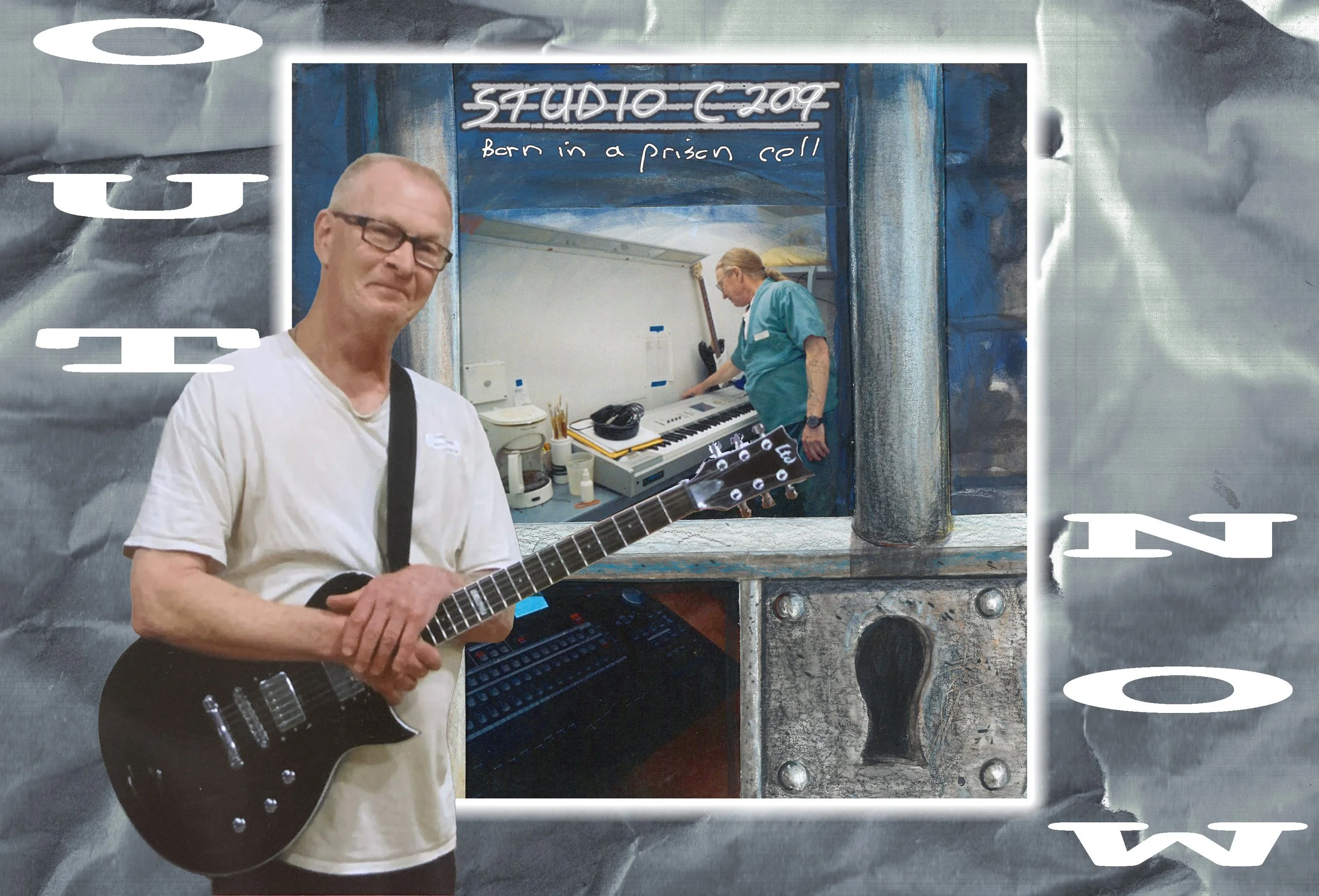
BL: One of the things I find fascinating about your career is that FREER Records' Instruments Into Prisons initiative helped make it possible for you to build a studio and record an album inside your cell. Most people can't imagine creating a professional body of work from a prison cell. What does that opportunity mean to you personally? Did you learn all your recording skills with the gear donated, or did you have previous knowledge?
MT: That opportunity still seems somewhat surreal...
At the time, if somebody had told me I had fallen into a Salvador Dalí painting, I might have actually believed it! Frankly, I was in shock the day that a previous warden ALLOWED me to demonstrate the viability of such a program by having all that equipment and being a steward of that equipment. It was a tremendously edifying experience for all of us, and it was never abused.
I did have some basic recording skills before ever coming to prison. Nothing fancy, and all analog stuff. But the theory carried over into the equipment that was donated by FREER Records via Ted Jamison, which included a wonderful KORG Triton ProX, a Fender Affinity Stratocaster copy, a TASCAM 2488 Neo, then a DP24SD, an SM58 mic, and a pair of Mackie powered monitors that I only used for mastering.
What I DID learn as a result of these wonderful donations is how beautiful it feels to really reach out to others and help them achieve their dreams, and see them grow in ways they didn't realize they could (myself included!!!).
BL: Being an adult who's a born-and-bred musician with the deepest passion for making music, who owns your masters and gets to create every day, has no rent, mortgage, or kids... do you think you're a person fulfilling their purpose?
MT: That is a pretty deep question, and it is not one with an easy answer by any means...
I don't believe in manifest destiny, or that my life's blueprint was drafted at the beginning of time. To clarify a bit, I DO believe in God, a Creator of all that is in existence, but I also believe we were allowed our free wills to live our lives and learn some serious lessons.
I doubt my ticket for life's journey was meant to be spent in a prison cell (animal cage, actually...) but because of horrible choices I made in my youth, nevertheless prison has been my residence for the past 47 years of my life.
I feel that I have been allowed to create a purpose that has empowered me to "give back" something with a very tangible worth to this beautiful society that my youthful ignorance and selfish blindness took so much from.
Please don't misunderstand my answer, though, because there is NOTHING that I can say or do to give back the most precious gifts that I stole from my victims and their families.
My "purpose"?
To give back the best that I can. In all I do.
Tenneson - “Greener Pastures” Official Video
BL: Do you think a person who will never come home, but gets to live out their passion, create art, and touch others through that art, can have a better life than someone who ONLY has physical freedom?
MT: Interesting that you asked that, because the answer is actually a resounding YES!
I am surrounded by a very real stone, rebar, and steel building called a "prison," but I have been blessed with some very wonderful people who helped me become so much more than I ever believed was even remotely possible as a child and young adult.
I have learned that none of us are just the sum total of our worst ten minutes of our lives...
We cannot change the past, but we don't have to be chained to it either.
BL: There are people walking free right now who are living in harsh, violent, poor, lonely, and deeply unhealthy conditions as well. They also have bills and have to somehow feed their families. Would you take their freedom (though their lives are horrible) and their conditions over your current life circumstances?
MT: Yes! I honestly would.
Because of the decades I've had to reflect on the entire life potential that I took for granted and virtually threw away, I would do anything for a second chance at life. I would be able to turn even the worst circumstances around and ultimately be able to not just survive—but thrive.
I wish I could go out there and reach out to those your question alludes to.
I wish I could feed the hungry, console the brokenhearted, encourage the youth that are me 50 years ago, save a thousand lives, and then a thousand more.
What I am very certain of is that I would never take a day of freedom for granted again.
And I would help others see the world through a child's eyes...
BL: So for me personally, I love your lyricism, and I love your chord progressions. Those are some of the things I love most about your work. I'm a big fan of Greener Pastures. That song actually inspired my previous questions.
"The grass is never as green as the spot where we stand in His grace..."
How true and beautiful.
And the guitar solo that follows is just as humble and sincere. You didn't use that moment to grandstand. It feels like an infinite parallel mirror of the lyrics, or an older gentleman standing up, taking off his hat, clutching it to his chest, and walking toward the altar with a lifetime of tears running down his face. Happy ones, sad ones... all formulating as a powerful wave of salty water, yet still a tender weep.
What's the average number of takes you do for your guitar solos? Is it one or two in the right space to nail the emotion of the song, or are you meticulous and tweak countless times until it lands?
MT: Easy question.
You'd be surprised to know that most of them are just raw, improvised expressions of whatever the music says to me at any given time. I don't STEP RECORD, PUNCH IN, or use loops.
I just prefer the raw energy and humanness of playing what I feel because... I feel it.
When I'm expressing something genuine and not trying to be something I'm not, it just comes out.
But what's really cool is that once a song has chosen a melody—or a lead—it's kind of etched into my memory if I ever play the songs live.
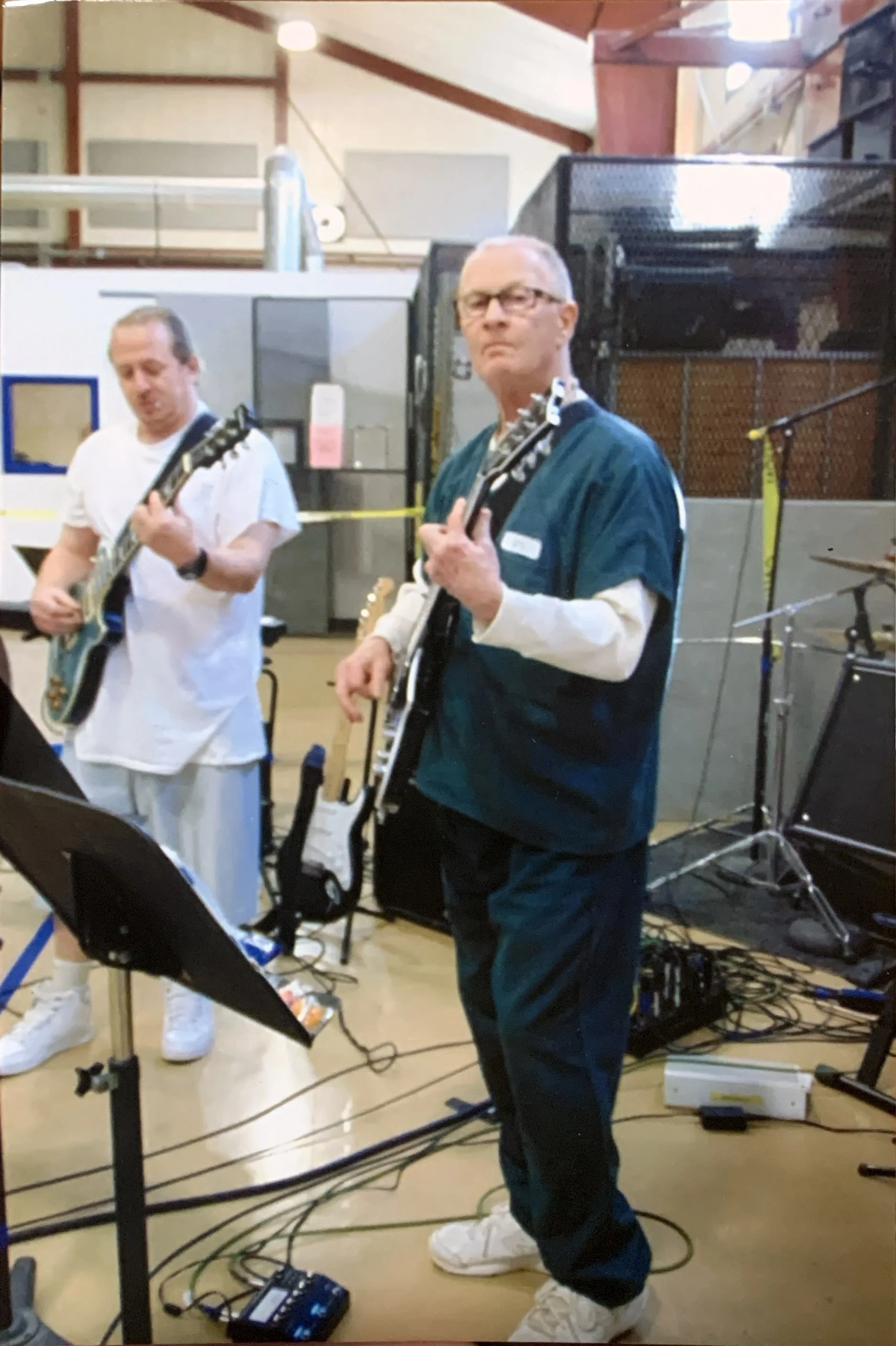
A recent photo of Mike taken at Territorial Prison, where he has since moved back since the recording of Studio C209. Courtesy: Tenneson
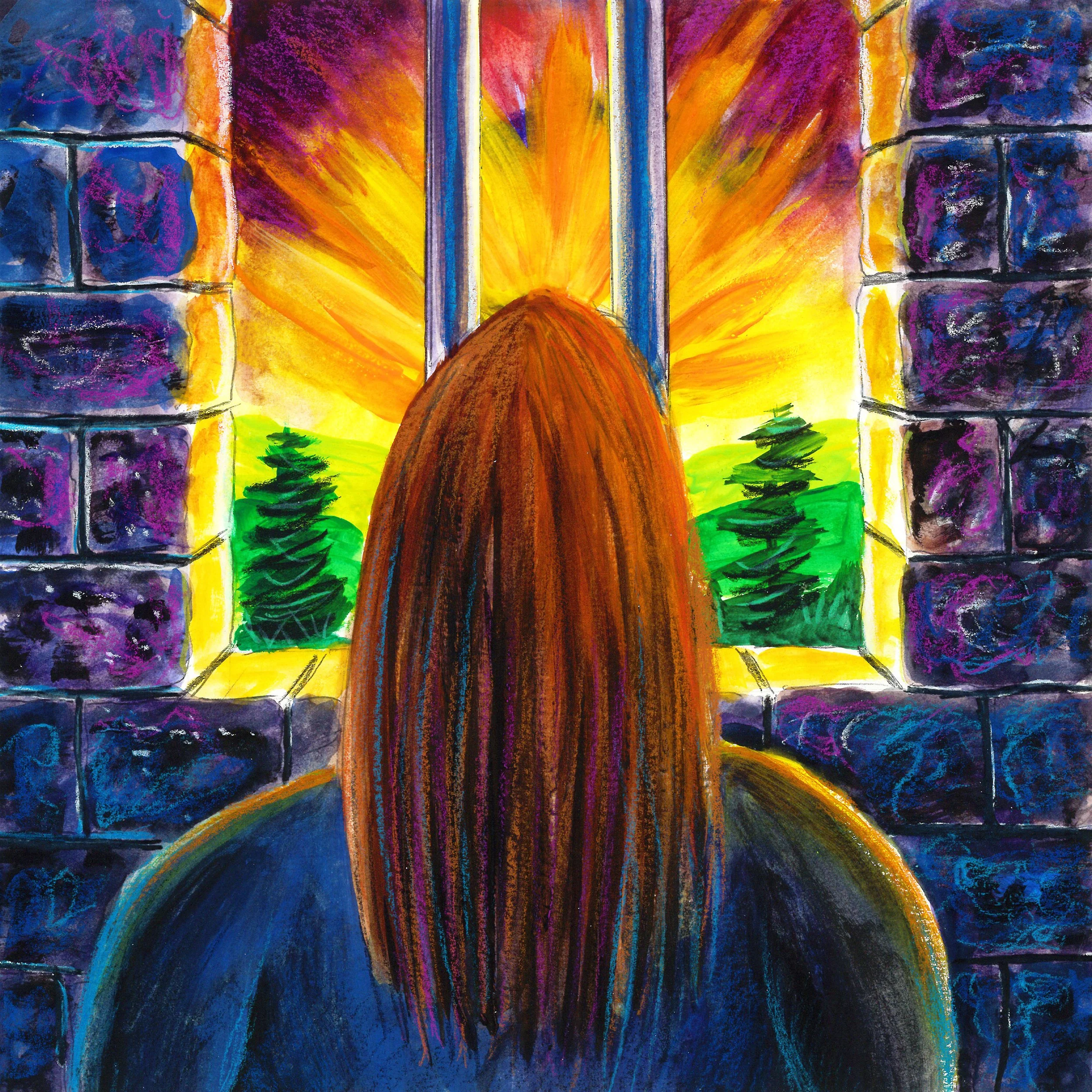
“Greener Pastures” single cover by Tenneson
BL: Tell me about the “Greener Pastures” artwork. What inspired your choices? Who is this person staring out the bars? I love that the sky and the wall of the cell are the same color. To me, that represents freedom of the mind. Tell me more about your thought process.
MT: The story of “Greener Pastures” was written several years ago when I was really not feeling it at a previous facility and was weighing all the pros and cons of a move. I had to wade through a bunch of internal baggage to decide if it was the place—or my state of mind, my own PERCEPTIONS perhaps—that needed changing.
Long story short, it turned out that BOTH were the culprit. The person is me staring out the window.
You picked up a lot of the vibe I was channeling. (Hmmm... you are becoming a worthy art critic.)
Yes, the sky and internal walls share the same hues. They are all related, as we all are to each other.
Despite our primal, Neanderthalic compulsion to inflict bodily harm upon each other, there is a very nuanced synergy that links all of us together, just like the colors you commented on in that picture. I didn't intentionally include that relationship in the composition, but your observation is actually right on point. It does exist nonetheless.
I guess the grass was just as green right where I was standing... because today I am back at the same place that I once penned the words of that song.
Full circle.
Tenneson - P.I.C. (Prison Industrial Complex) - Official Video
BL: One of my favorite things about your song “P.I.C.” [Prison Industrial Complex] is how the guitar evolves. The whole song starts out dark and intense. Your vocal melody almost feels like a psychosis chant, and then the guitar comes in feeling very bluesy. As the song develops, it becomes more spacious and expansive, almost trippy for a moment.
Whose idea was it for the song to evolve sonically like that throughout? Did you mix the guitar yourself on the demo, or did Fury, Matthew (our mastering engineer), and the post-production team help shape that atmosphere?
MT: This... is a tough one for me.
“P.I.C.” is about something much bigger than just concrete and steel cages confining 2.3 million people in American "prisons." It is one that I wanted a listener to FEEL the eerie, creepy, cold, metallic, brittle sharpness, and feel the demeaning reality of just a few moments of what we collectively are exposed to for years and decades. “P.I.C.” was NOT written for a three-minute radio blurb, nor was it written to pander to public approval ratings. It was a vignette into my world... a world that society never truly feels the effects of, yet they wonder why we often come out more fucked up than when we went in.
I honestly do regret that I surrendered P.I.C. to be edited, two of its verses surgically removed, and that sonic landscape that I crafted to be cut in less than half.
Not a critique. Just a regret. I would like to release the original one day as "remastered." Oui?
Yes, I mixed it myself! Ha... I thought you knew?
Yes, I mixed the guitar. Everything you hear on those demos was written, played (with guitar and keyboard), sung, recorded track by track, mixed down, then [first pass] mastered on the 24-track TASCAM units that were sent in by Fury and Ted Jamison, etc.
Most of the songs on C209 were only MP3 files.
They were literally my very first experimental mixes when I first got the TASCAM 2488 Neo. I did a few songs on it, burned a quick MP3 copy, and then some idiots in the cell next to me were smoking spice and meth and blew the damned circuit out in the wall outlet adjacent to my cell, which sent a surge to my outlet and blew out the motherboard on the TASCAM unit, along with everything that was on the hard drive.
So the only thing that I had left was those MP3 mixdowns. I had fully intended on doing all those songs over with a real drummer, a decent guitar, and an amp.
When Fury decided to go ahead and put out C209 on FREER Records, he suggested that I allow Matthew to apply some saturation, basic compression, volume leveling, and a few edits here and there to shorten a few of the songs.
I took his advice, and other than “P.I.C.,” I feel we made the right choice. But I feel like P.I.C. was neutered... :(
It was not written as a public relations tool. It was written to express a very dark, harsh, monotonous, eerie, inhumane environment.
But I already made the choice, so it's water under the bridge. Fury had his reasons for suggesting the edits. Politically, for future access to our prison, it makes sense not to hurt their feelings, so I swallowed my pride and agreed to Matthew's edits, and then another by Fury.
I'll get over it. (Whaaaaa....) 🙂
BL: Has prison taken more from you than music has given back to you, or has music somehow balanced that scale?
MT: Interestingly, music, art, and writing have allowed me to better express the blessings, insights, and long years of introspective realizations that I never would have become aware of had I not had the prison chapters of my life.
I have simply made the best that I could with the situation that I PUT MYSELF IN DUE TO MY ACTIONS.
Most people won't truly empathize with that statement, but it simply is what it is.
Prison hasn't taken anything from me that I didn't give up by violating the codes of civility in our American society.
I was the enemy. I made my bed. Now I have learned not to complain about my lot.
BL: Being a believer in Jesus Christ, have you ever thought deeply about Judgment Day? If you have, can you share some of those scenarios? What have you imagined it may look like for you?
MT: Once upon a time, long ago, I assumed I was going to rot in hell for the things that I did to people.
I was really touched deeply by the grandmother of one of the men I killed in Denver. She used to send me Christmas cards for the first five years of my incarceration, saying, "God loves and forgives you, so do I, and maybe one day you can forgive yourself..."
I decided back then, if that woman could forgive me, how much more could our Creator?
And I just began to change inside. It was subtle, yet profound. I believe I will have some issues when I face our Creator, but if I am judged by the true contents of my heart, I guess we'll just have to see. I have made my peace, though.
BL: Do you feel like you've saved anyone's life during your lifetime? If so, can you tell us about that person and that relationship?
MT: Funny you asked THAT question... Ironically, the answer is yes. Literally in a physical sense, and in more subtle ways. I have intervened in more than just a few situations where there were serious threats of death. Typical prison, closed-community, predator-on-prey kinds of scenarios. I know you know about that. So yes, there were those. And then there's the more subtle, if somewhat esoteric, interactions that I have been privileged to be a part of that made real changes in the trajectory of some of my music students over the years. Honestly, there are quite a few, actually. I could (and should...) write extensively about this. A book even.
BL: How often do you think about your victims? Are there seasons when you think about them more and seasons when you think about them less? Do you think about all five victims pretty equally, or are there some whose memories weigh on you differently?
MT: I think of my victims every day and have never stopped thinking of them.
I would do ANYTHING to bring them back.
To give their families back what I so viciously and callously stole from them back in the 1980s.
For decades I hated myself for what I had done to those people. Innocent people. It is true that when you take another human being's life, you also lose a part of yourself. For years I felt empty inside and wanted to take my own life as some sort of self-imposed justice, but realized it would only be a final act of cowardice by a man who had made the wrong choices most of his life.
I had a deep spiritual epiphany that convinced me that my only choice was to live a life that would attempt to give back something of substance to our society. I didn't even know where to begin. The Bible gave me a blueprint to start with. I owe society a debt that is not able to be repaid. Nothing I can do can reverse the damage I have caused. I only pray for the guidance and help to possibly prevent someone else from going down a similar path.
BL: Do you think there are any crimes that involve such a level of harm that a person should never be released, no matter how much they've changed?
MT: I don't know if the right criteria is actually the crime itself so much as the reasons the actions occurred in the first place. This question goes right to the heart of the previous question regarding society's obligation to recognize growth.
We also have to factor in whether we want to rehabilitate our citizens to a level of wellness where they CAN—and predictably will—be positive, productive, healthy contributing members of society.
In short, we have a continuum of two extremes: Punishment/Revenge versus Healing/Rehabilitation.
We are rightfully shocked when we see the wake of destruction left in the path of a person in the throes of a suicidal, violent crime spree. Yet so little attention is ever paid to finding out WHY it happened in the first place. We are too quick—and often too ignorant of the truth—to simply blame the offense on a person because they are "bad," rather than recognizing that they are hurt, broken, destitute, and desperate.
And then asking ourselves:
"How can we help this person heal?"
The power of a testimony from a broken person who was healed by the loving grace of a group of people is profoundly compelling.
Love heals all.
BL.: Do you think society is obligated to recognize a person's growth, or is growth something that only matters between you and God?
M.T.: This really isn't an either/or question because I believe that YES, society is—and should be—obligated to recognize a person's growth. It would require true, objective standards to be developed, and the training of personnel capable of assessing the progress of every man, woman, and child caught up in every level of our criminal just-us system.
We should have professionals trained to intervene in the earliest years of individuals' traumas and have the resources to provide opportunities that could dramatically turn the vast majority of broken people's lives around. This could easily become a book-length dissertation. It is SO complex, yet... not.
Simply stated: "Hurt people hurt people."
When people feel unimportant, ignored, unwanted, and are told they are no good, ugly, stupid, pieces of shit, or that they will never amount to anything... all of that has a huge impact. It effects everything they believe about themselves, the people around them, and the world itself. Then add hunger, poverty, inadequate education, physical abuse, sexual abuse, constant violence, and fear for one's life and general well-being—and you have a pretty accurate picture of the life experiences of the majority of America's two million-plus prisoners and the more than ten million people still under civil commitments of parole or probation.
Most have never been properly evaluated to determine what truly set them on the paths that led to criminal acts. Much less given realistic intervention programs, meaningful education, or encouragement to become all they can be.
Is society obligated?
I'll be very polite here and simply say:
"Yeah, you're fucking right society is obligated."
Our focus should be on creating our national infrastructure on every level and leaving a healthy, prosperous, honorable legacy for our children to build upon—not spending trillions of dollars feeding our youth into a war machine created by draft-dodging politicians so they can blow up people on the other side of the world we don't even know.
If we spent a fraction of that money retooling our criminal justice system, or modeling it after Scandinavian and other European countries, what a paradigm shift that would be.
But that would require the citizens of the United States to truly become united as a collective body and vote—or simply fire—the lame ducks and pocket-lining leeches that have infested our highest offices for too long.
As for God?
My heart tells me that God is more interested in our heart's contents, motivations, and intentions than outside appearances. God knows what has truly changed and grown inside. I believe God wants us to simply love God and love each other as ourselves.
Sound simple?
Absolutely not simple.
It's easy to love the ones we love, but what about the ones we don't? Indeed, the Greatest Commandment. Please don't misunderstand. I am in no way judging or ridiculing society. We are ALL in this together, and the collective whole of our current social dysfunction will not change for the better unless—and until—we change the lens through which we view crime.
What it is. Why it is. How we can change the dynamics. All who envision a better future for our beautiful country and world have an obligation to fight for the necessary changes.
One person CAN make a difference.
Imagine a million.
Ten million.
ONE HUNDRED MILLION..
BL: One of my critiques of your music is that, for my personal taste, you sometimes stay with the same melodies vocally for a little too long. That's just my preference. Plenty of great artists do that, so it's not a criticism of your artistry as much as it is an analysis of my listening pleasures. Can you tell me about your writing process? When you choose melodies vocally, do you have a method? Is there a creative process behind it, or is it more instinctive and based on feeling?
MT: When I am really moved by something, I write about it, paint it, or sing and play music that expresses what I feel about certain things. I don't follow traditional commercial methods or conventions—some of which I'm not even aware of.
Truth is, I just write what I feel. Usually my songs are written in minutes and seldom edited for content or political correctness.
I always try to be honest. Never "clever." Never "cool." Never pretentious.
Simple? Yes.
Today I am very much a fan of being genuine, honest, and vulnerable. I wish somebody could have taught me to be this guy 60 years ago when I was just beginning first grade. Hopefully some young person will hear this record or read these words and maybe I can be the mentor I wish to God somebody had been for me forty years ago.
Something I've never really mentioned is that, to me, the words—the message—are the most important part of my music. That's why my vocals are always in the forefront of my mixes and never saturated with effects or Auto-Tune. (I'm NOT a fan.)
I don't have any delusions about being a great singer, musician, or human being. But my music and visual art are simply expressions of the things I see, hear, feel, and experience in this thing of beauty, horror, gentleness, and harshness we all call life.
It is not right or wrong. It just is what it is.
In this instance, it is an album miraculously recorded in a Colorado prison cell by a man with five life sentences.
BL: I love the “Father's Call” art piece. It made me feel like you want to be used as a vessel for the Lord's love and light. Did I read that wrong?
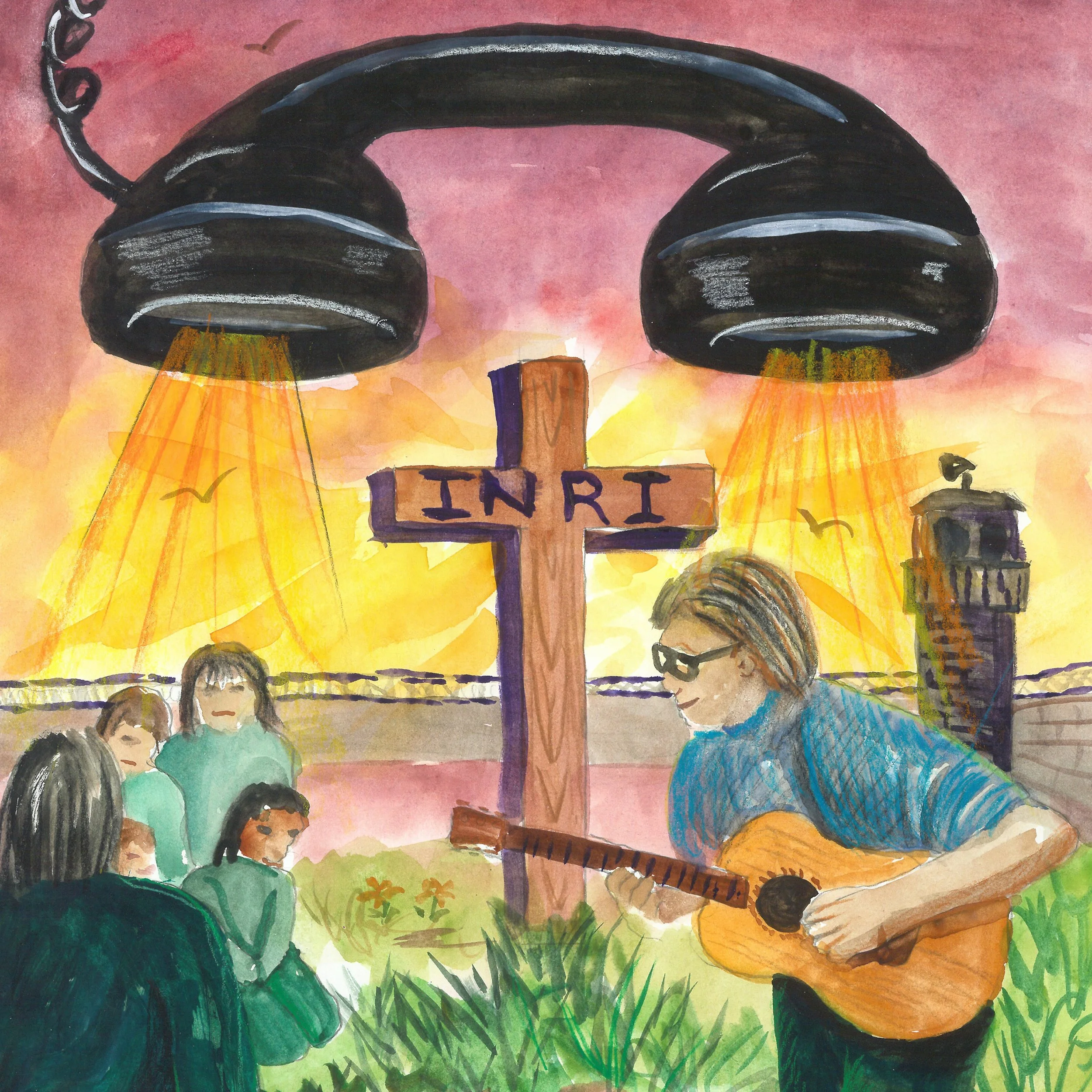
“The Father’s Call” single cover by Tenneson
I see only two flowers and they're directly underneath the cross because there's life... for He has risen, HALLELUJAH! I wish you didn't put that bird on top of the phone because the rest of the birds are in the Lord's direct sonic gaze and grace! HAHAHA...
I'm becoming quite the art critic. I've learned from the best—Fury Young! LOL! Tell me about that piece.
MT: Your interpretation of it is actually much more detailed than my intention. It was really just a sort of metaphor for the childlike mindsets of the dementia patients that we played for every Friday a few years ago. [The song depicts] the day that one gentleman got up out of his wheelchair, and what he said shocked the whole ward. It was dead silent as the nurses, staff, and other patients stared with their mouths open and eyes wide. He hadn’t spoken in years.
The telephone?
"Jesus on the mainline, tell Him what you want... you just call Him up and tell Him what you want..."
That was really it. Just a quick raw pencil sketch, some watercolor washes, and that was it. Very simple message.
Like my music, I don't try to be "deep."
I CAN be...
But most people don't track with things that require more than a 30-second blurb. Besides, the issues I do write about are in everybody's face constantly anyway.
I just write songs about them.
Tenneson - “Nobody’s Listening” - Official Video
BL: “Nobody's Listening” has this distorted rock feel to it that I really like, but the main lyric always gets me.
"No one gives a damn anymore... till somebody dies."
I actually got stuck on the word anymore.
Murder is one of the oldest human behaviors. War, slavery, torture... it's all been a thing. We've been killing each other forever, yet we still act shocked every time it happens. Just like death is the one thing all mortals are guaranteed, yet we never get used to it.
So my question is: What point in time are you comparing today to when you say "ANYMORE" in that lyric?
MT: That song was inspired by the typical evening news one night.
The newsman goes: "BREAKING NEWS! AN INDONESIAN AIRLINES JET IS REPORTED TO HAVE BEEN SHOT DOWN AND IT IS SUSPECTED TERRORISM!"
Then another:
"BREAKING NEWS! THE BTK KILLER STRIKES AGAIN! ANOTHER VICTIM CAUGHT IN HIS SIGHTS!"
Remember a few years ago when that father and son were sniping people out east?
Then they were ranting about ozone depletion and all kinds of other negative shit. And in three hours, not a single positive, edifying story.
So the song wrote itself.
The music just starts with a click track—as it always does—and then that little synth melody came to mind. I laid a track, then the drum track that I played in real time on the KORG, then the vocal, then a couple guitar tracks.
Pretty much one and done.
BL: Which instruments did you lay on the album and in what order did you play them? Does your guitar create the skeleton for most of your tracks, or do you start with lyrics? What's your process most of the time?
MT: All of Studio C209: Born in a Prison Cell was written, all instruments played, all recording, mixing, and [pre-]mastering done by myself in my cell with a KORG Triton ProX, Fender Affinity Stratocaster copy, Yamaha C40 Classical Guitar (“The Father's Call”), Shure SM58 microphone, and several TASCAM units, like I mentioned earlier.
I generally begin with a lyric, mentally playing with the arrangement until I feel some kind of vibe. Then, when I feel it, I lay out a simple click track followed by whatever instrument is going to be most prominent in the song. It varies.
My primary instrument is guitar, but I write most of my songs on piano. Not sure why, really. I just love the piano. I yearn to have a really decent digital piano in my cell so I could immerse myself in it for eight or ten hours a day.
Maybe someday it will happen.
I always lay a click track first, followed by a melodic rhythm—either guitar or keyboard—and then just let the song tell me what it wants.
If that makes sense? Feel me?
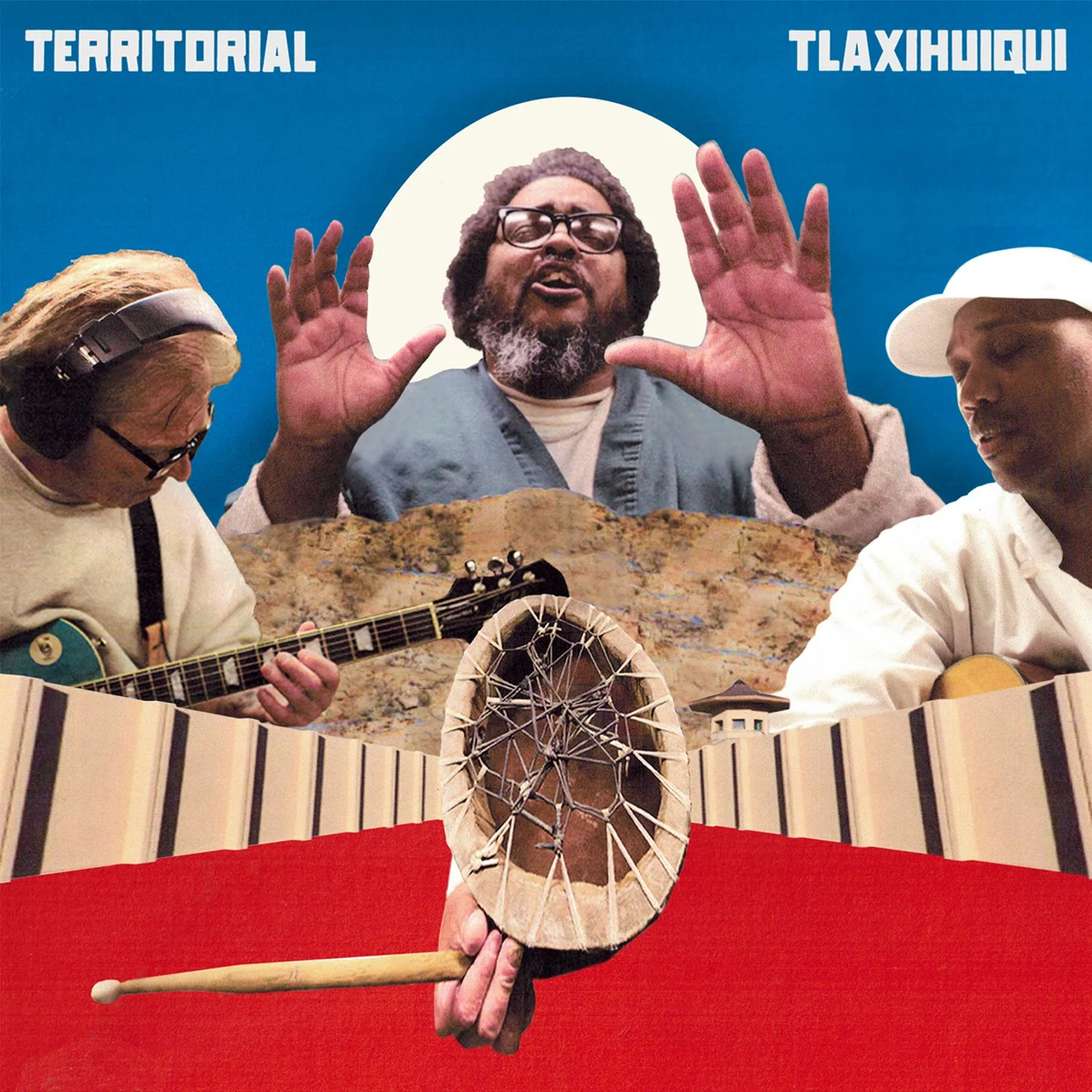
Territorial’s 2021 album Tlaxihuiqui, featuring Tenneson on the cover (left). The album that started it all for FREER in Colorado.
BL: When and where do you tend to catch inspiration the most?
MT: Most of my deeper inspiration normally happens late at night or early in the morning, which is not good for most prison musicians because we are normally NOT allowed instruments in our cells, despite my showing how well it worked in one of Colorado's worst facilities [Sterling] where C209 was recorded.
BL: What do you want people to learn or resonate with from your album Studio C209: Born in a Prison Cell?
MT: Most importantly, I hope the music, the message, and the concept of a project like this—created almost entirely in the GP cell of a pretty hardcore Colorado prison—is seen as a window of hope for millions of prisoners nationwide.
And for society to see it and truly realize that:
"We the (Incarcerated) People are so much more than the sum total of our wrongful actions."
And we could be exponentially more if opportunities like this were promoted on a legitimate large scale rather than being choked off at every attempt to further these wondrous expressive mediums.
What this album represents is an incredible moment when the stars lined up. I truly feel that God opened a pathway for this little LP to be created and sent out without incident to FREER Records, where our wonderful staff and production crew all contributed in various ways to give this little creation that was "born in a prison cell" enough nurturing to ensure it survived its journey to the mainstream.
Some will think prisoners don't deserve such an opportunity. I agree. I actually "deserved" the death penalty under Colorado law in 1987. My life was spared by one juror who said she saw something in my eyes and had a gut feeling I might be worth saving.
That was another one of those God moments.
I deserved no mercy. I did deserve to die. Yet I was shown mercy and spared.
For what?
I used to wonder.
I'd been a full-blown screw-up most of my life up to that moment. But something touched me deep inside, and it had to be God because nothing else could have penetrated the walls I had built around my heart, emotions, and vulnerabilities—things I did to protect myself from being hurt again after being abused physically and sexually as a very young boy.
What happened in the 1980s was terribly wrong. In a twisted, drug-clouded mindset, I felt I was paying back every rotten S.O.B. who had ever hurt my young single mom and me while society stood by and ignored our cries for help.
But... I... was... WRONG. TERRIBLY WRONG.
I lashed out at everybody out of fear, often pure terror from drug-induced paranoia that rendered me little more than one of the zombies you see on The Walking Dead.
In 1991, at Limon Correctional Facility, I dropped to my knees on the hard, cold floor of my cell and cried out like never before for God to either give me the courage to take my own life so I wouldn't hurt anybody else—or grant me the wisdom to become a decent human being and help me see how I could give something back to the society that I took so much from.
Today I have very little, some would say. But all who know me know that I will give all of myself freely to anyone who needs help.
In the end, I believe that matters.
BL: Well, that's all the questions I have for now. Thank you for sharing your heart and soul with us. Keep pouring into society, Tenneson. God loves you, and so do I, my brother in Christ. Wishing the album success in helping save some souls.